News
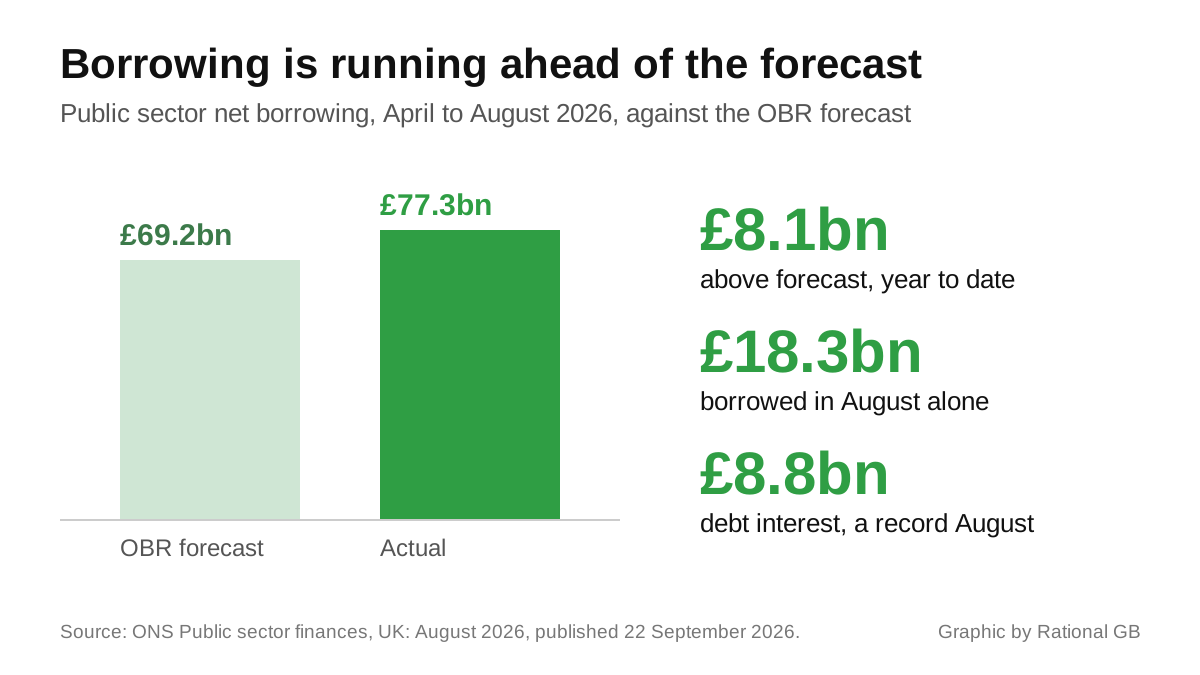
Borrowing Hits £18.3bn, £8.1bn Above the OBR Forecast
Three official releases in five days, and they point in awkwardly different directions. Government borrowing is running well ahead of the official forecast, household spending is quietly growing, and the cash access programme passed a milestone. None of this changes a long-term plan. One of it is worth thinking about before the next fiscal event.
Borrowing came in £8.1bn above the OBR forecast for the year so far
On 22 September the Office for National Statistics reported public sector net borrowing of £18.3 billion in August 2026, up £2.9 billion on August 2025 and the second highest August on record in cash terms, behind 2020. For the financial year to date, April to August, borrowing was £77.3 billion. That is slightly below the £79.5 billion borrowed over the same months last year, but it is £8.1 billion above the Office for Budget Responsibility’s forecast, with the August figure alone £3.5 billion over. The ONS attributes the gap to central government spending on benefits and services running ahead of what was projected.
The other number in the release is the one that compounds. Central government debt interest payable was £8.8 billion in August, the highest August figure since monthly records began in 1997, and £2.1 billion of that came from the inflation uplift on index-linked gilts following recent RPI movements. Roughly a quarter of the UK’s debt stock is index-linked, which is why an inflation surprise shows up in the public finances within weeks rather than years.
What to do with this as an investor is mostly nothing. An overshoot of this size before a fiscal event raises the odds of tax changes rather than spending cuts, and the tax levers that are easiest to pull are the ones that touch savers and investors: allowances, thresholds and dividend rates rather than headline income tax. The rational response is not to guess which one, it is to use the allowances you already have while they exist. If you have unused ISA capacity this tax year, using it is a decision you would not regret either way, and cash ISA versus stocks and shares ISA covers where money belongs depending on when you need it. The bulletin is at the ONS.
Retail sales rose 0.5% in August, and online is now 28.8% of spending
The ONS reported on 18 September that retail sales volumes rose 0.5 per cent in August and were 2.4 per cent higher than August 2025. Non-store retailers recovered from a weak July, food stores and supermarkets were strong across the quarter, and alcohol sold well on promotions, warm weather and the World Cup. Department stores bounced back after July stock problems. Fuel was the drag, with volumes falling as prices rose sharply.
Online spending values were up 2.5 per cent on the month and 10.1 per cent on the year, taking the online share of total spending from 28.4 per cent in July to 28.8 per cent in August.
The useful read is that consumers are not retrenching, which is one reason inflation has been stickier than the Bank would like, and therefore one reason not to assume rate cuts are coming. If you have been waiting in cash for a better savings rate, the waiting is not obviously being rewarded. The release is at the ONS.
The 250th banking hub opened, in Chepstow
On 18 September the Treasury announced that the UK’s 250th banking hub had opened in Chepstow. Hubs are shared counters, run by the Post Office with the major banks rotating staff through them, set up where branch closures have left a town without face-to-face banking.
This is a small story with a practical use. If you are holding a large cash balance and your reason is that you want a branch, a hub in your town changes the calculation, because most everyday counter services are available there. It does not change the other argument, which is that cash earning less than inflation loses purchasing power whether or not you can withdraw it in person. How much to invest per month covers where the line between an emergency fund and investable money sits. The announcement is on GOV.UK.