Tax-Efficient Investing
Tax-Efficient Investing UK: The Order That Saves Most
Tax-efficient investing in the UK is mostly a sequencing problem. The wrappers themselves are simple, the allowances are published, and almost nobody’s returns are decided by which fund they chose. What decides the outcome is the order money goes into the accounts, and whether the allowances that reset every April get used or thrown away. Two changes make 2026/27 a year where the sequence matters more than usual: dividend tax went up in April, and from April 2027 the cash ISA limit drops for most people. This page sets out the allowances as they stand, the order that works for most situations, and what the 2027 change means for money you are holding now.
All figures are for the 2026/27 tax year, verified against gov.uk in August 2026. This is information, not personal advice.
The allowances, as they stand
| Allowance | 2026/27 | Notes |
|---|---|---|
| ISA allowance | £20,000 | Across all ISA types combined |
| Cash ISA share of that | Full £20,000 until 5 April 2027 | Drops to £12,000 for under-65s from 6 April 2027 |
| Capital gains annual exempt amount | £3,000 | Per person, cannot be carried forward |
| Dividend allowance | £500 | Per person |
| Personal savings allowance | £1,000 basic rate, £500 higher rate | Nil for additional rate |
| Pension annual allowance | £60,000 | Tapered for high earners, subject to earnings |
The rates that apply once you exceed those:
- Dividends above the £500 allowance are taxed at 10.75% basic rate, 35.75% higher rate and 39.35% additional rate. The basic and higher rates each rose by two percentage points from 6 April 2026.
- Capital gains above the £3,000 exemption are taxed at 18% within the basic rate band and 24% above it, for gains on or after 6 April 2026, per gov.uk’s Capital Gains Tax rates. Note that the lower 10% and 20% rates on non-property assets that appear in many older articles no longer exist. If a page you are reading still quotes them, it has not been updated in two years.
The two allowances people waste most are the CGT exemption and the ISA allowance, and for the same reason: both reset on 6 April and neither carries forward. An unused £3,000 gains exemption is simply gone.
The order that works for most people
This is the default sequence, not a rule. Individual circumstances override it.
- Clear expensive debt first. Nothing in the tax system beats a guaranteed return equal to a credit card interest rate. This is not investing advice dressed up; it is arithmetic.
- Take the full employer pension match. An employer contribution you decline is an unconditional pay cut. It also comes with tax relief on top, which no other wrapper matches. Our page on pension tax relief explains how the relief works at each rate.
- Build cash you can reach, three to six months of outgoings, in a savings account or cash ISA. Whether it needs an ISA wrapper depends on whether the interest exceeds your personal savings allowance: £1,000 at basic rate, £500 at higher rate, nothing at additional rate.
- Fill the stocks and shares ISA. Simple, flexible, no tax on gains, dividends or interest, and no tax or reporting on the way out. For most people this is where the bulk of long-term investing should sit. Our cash ISA vs stocks and shares ISA page covers the choice between the two.
- Add to the pension beyond the match, particularly if you are a higher-rate taxpayer. Relief at 40% going in is a substantially better deal than relief at 20%, and if you expect to be a basic-rate taxpayer in retirement the arbitrage is the single largest tax saving available to most employees. Salary sacrifice adds the National Insurance saving on top.
- Only then invest outside a wrapper, and if you do, put the tax-inefficient holdings inside the wrapper and the efficient ones outside.
Steps 4 and 5 swap places for some people. The pension wins on tax relief; the ISA wins on access. If you might need the money before 57, the ISA is the answer whatever the relief calculation says.
What changes on 6 April 2027, and what to do now
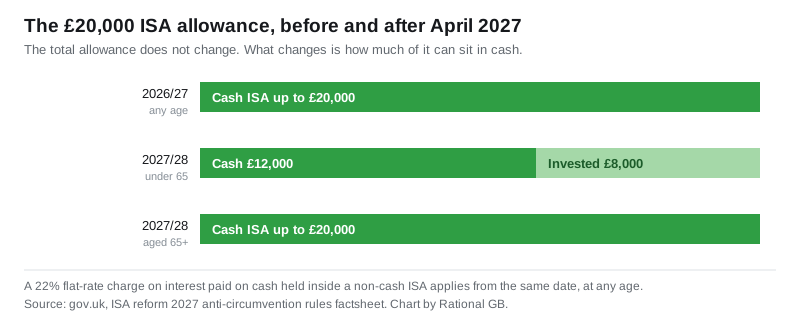
From 6 April 2027 the cash ISA limit falls to £12,000 for those under 65. The overall ISA allowance stays at £20,000, so the remaining £8,000 has to go into a stocks and shares, innovative finance or lifetime ISA. People aged 65 and over keep the full £20,000 cash limit.
The government published anti-circumvention rules alongside it, and these are the part almost nobody has read. Three of them will affect ordinary investors:
- A flat-rate 22% charge will apply to interest paid on cash held inside a non-cash ISA. If you keep a large cash balance in your stocks and shares ISA between trades, or park money there waiting for a decision, that interest will be charged at 22%. This applies to over-65s too.
- Portfolios made up entirely of cash-like assets become non-qualifying. Money market funds are the defined target. Holding 100% of a stocks and shares ISA in a money market fund will not work as a cash-ISA substitute.
- Transfers from a non-cash ISA into a cash ISA will be prohibited. Transfers the other way, from cash into stocks and shares, remain allowed. Over-65s are exempt from this restriction but not from the other two.
The practical implication for 2026/27 is narrow but real: this tax year is the last in which someone under 65 can put the full £20,000 into cash. If a large cash ISA contribution is genuinely right for your circumstances, the window closes on 5 April 2027. That is a fact about timing, not an argument for holding cash. For most people with a long horizon, an all-cash ISA was already the wrong answer.
Where to hold what, if you invest outside a wrapper
Once you are investing beyond £20,000 a year, asset location starts to matter. The principle: the wrapper is scarce, so give it to the holdings that would otherwise be taxed hardest.
Inside the ISA or pension, by preference:
- High-yielding equity funds and dividend ETFs, because dividend tax now starts at 10.75% and the allowance is only £500
- Bonds and bond funds, where the return is mostly interest
- Anything you expect to trade, because every disposal outside a wrapper is a CGT event
- REITs and property funds, whose distributions are taxed as property income rather than dividends
Outside, if something has to be:
- Accumulating global equity trackers with low yields, where most of the return arrives as capital gain you can realise gradually against the £3,000 exemption
- Holdings you intend to keep for decades and never sell
Two techniques worth knowing for the unwrapped portion. Bed and ISA means selling a holding outside the wrapper and buying it back inside, realising a gain deliberately against this year’s £3,000 exemption. Most platforms run it as a single instruction. And inter-spouse transfers are made at no gain and no loss, so a couple can use two £3,000 exemptions and two £500 dividend allowances instead of one, provided the transfer is genuine and unconditional.
The mistakes that cost most
- Leaving the ISA allowance unused and investing outside it anyway. The commonest and most expensive error. It costs nothing to use the wrapper.
- Choosing a platform on headline fee alone. For a small portfolio, a percentage fee usually beats a flat fee; for a large one, the reverse. Our cheapest stocks and shares ISA platform comparison works through where the crossover sits.
- Forgetting the CGT exemption entirely. £3,000 of gains realised each year, deliberately, is £3,000 of future tax avoided. Most people realise gains only when they need the money, by which point the accumulated gain exceeds the exemption several times over.
- Ignoring dividend tax on a modest unwrapped portfolio. At a 3% yield, £500 of dividends arrives at around £17,000 invested. Above that, a higher-rate taxpayer is paying 35.75% on the excess.
- Treating the pension as untouchable rather than inaccessible. It is not locked away for ever; it is locked away until 57. For money you will need at 45, that is fatal. For money you will need at 65, it is irrelevant.
- Reading last year’s figures. Dividend rates changed in April 2026 and CGT rates changed in October 2024. A surprising number of guides still quote the old ones.
For the wrapper-by-wrapper detail, see our pages on ISAs explained, UK pensions explained and the SIPP vs workplace pension vs ISA comparison. If you are saving for a first home, the lifetime ISA has a 25% bonus that changes the sequence above entirely.
Frequently asked questions
What is the most tax-efficient way to invest in the UK? Use the wrappers in order: employer pension match first, then a stocks and shares ISA, then additional pension contributions, then unwrapped investing. The ISA removes tax on gains, dividends and interest with no tax on withdrawal; the pension gives relief at your marginal rate going in but locks the money until 57.
What is the ISA allowance for 2026/27? £20,000 across all ISA types combined. For this tax year the whole £20,000 can still go into a cash ISA, but from 6 April 2027 the cash limit falls to £12,000 for anyone under 65, with the balance having to go into stocks and shares, innovative finance or a lifetime ISA.
How much can I earn in dividends before paying tax? £500 a year, on top of your personal allowance. Above that, dividends are taxed at 10.75% for basic rate taxpayers, 35.75% for higher rate and 39.35% for additional rate. The basic and higher rates both rose by two percentage points on 6 April 2026.
Do I pay capital gains tax on shares in an ISA? No. Gains inside an ISA are free of capital gains tax and there is nothing to report on your tax return. Outside an ISA, the annual exempt amount is £3,000 and gains above it are taxed at 18% within the basic rate band and 24% above it.
Is a pension or an ISA better for tax efficiency? The pension is more tax-efficient for a higher-rate taxpayer who expects to pay basic rate in retirement, because relief goes in at 40% and comes out at 20% on the taxable portion. The ISA is better when you might need the money before 57, and it is simpler, since withdrawals are entirely tax free.
What is the 22% charge on ISA cash? From April 2027, a flat-rate 22% charge will apply to interest paid on cash held inside a non-cash ISA, such as an uninvested balance in a stocks and shares ISA. It is part of the anti-circumvention package accompanying the lower cash ISA limit, and it applies regardless of age.